
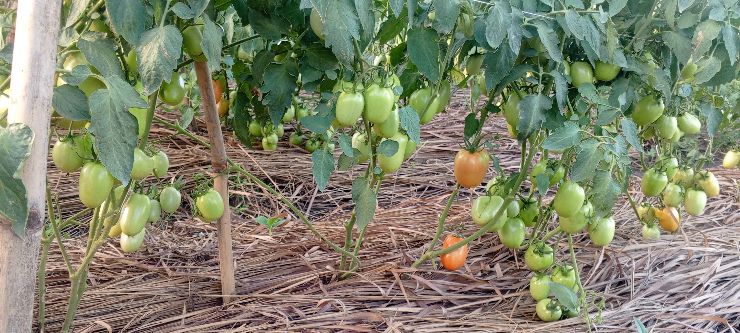
Oyam, Lango | Farmers in the Lango sub-region, northern Uganda, are among those practising and perfecting a new money-making climate-smart technique which guarantees food security among small-holder farmers in Sub-Saharan Africa.
The new technique is known as “Pfumvudza”, named in the Shona language in Zimbabwe where it was first discovered to mean a new beginning. It empowers households to produce more food on small plots while conserving soil moisture and improving resilience to climate shocks in their local climate.
The technique is being promoted in districts in Northern Uganda by the Climate Smart Jobs (CSJ), a transformative agribusiness organisation working in the region with funding from Palladium UK.
Premised on four key principles: minimum soil disturbance (minimum tillage), water conservation through mulching, crop rotation and precision farming, in which plant nutrients (manure or fertilisers) are concentrated in planting basins, also known as planting stations.
The model or technique is effective for smallholder farmers because the entire field is not ploughed intensively, but small planting holes are prepared and enriched with compost or manure. It is here that four seeds are strategically dipped and covered with a thin layer of soil protected with a blanket of water-conserving mulch.
The mulching conserves soil moisture for long even in less rainfall, as it also suppresses weeds. Experts say this significantly improves soil fertility around the plant.
Across Lango sub-region’s districts of Lira, Oyam and Alebtong, farmers are already test-driving Pfumvudza for effectiveness. Crop yields are already translating into increased household income for many participants.
Grass to grace
The technique encourages farmers to maximise available farm nutrients by concentrating manure or fertiliser inside localised planting holes so that nothing is wasted. This, in turn, supports smallholder farmers who lack adequate capital for big investments in fertilisers for large acreage of land.
That is the testimony of Simon Ojok, a smallholder farmer from Minakulu sub-county in Oyam district who grows maize, vegetables and keeps poultry.
His food growing pattern was grossly disrupted by the changing rainfall patterns before he adopted the Pfumvudza model. He was dependent on poor-quality seeds he would preserve from the harvest of the previous season or year.
“The technique introduced us to the use of improved certified seeds, proper fertiliser application and mulching – all of which have transformed the way we grow food and make money from them,” Ojok explained during an interview.
Ojok used to close the season’s hard work with just five sacks of unthreshed maize grains from an acre of land. Pfumvudza now gives him 15 sacks, three times his effort, significant enough for a smallholder farmer to afford food all year round. He sells part of the grains for other needs while feeding his poultry on it as well.
In neighbouring Lira district, Joan Apio from Amac sub-county says the model has significantly increased her production of soya and maize despite unpredictable weather patterns being on the increase over the last five years.
“I used to harvest five bags of soya from four acres and 10 bags of maize from three acres. After adopting Pfumvudza last year, my soya increased to 20 bags while maize rose to 40 bags,” she explains.
Apio says she now plants certified foundation seed, which attracts a better market price than ordinary grain. Improved seeds bring climate resilience qualities to farmers, including being fast maturing, drought-tolerant and high-yielding. Income also increases along the production frontier.
West Nile sub-region is part of the geographical North in which the Pfumvudza model is being promoted by Climate Smart Jobs. Farmers in it face similar climate impacts – declining soil fertility, average rise in temperature and erratic rainfall, which often wipe out entire crops at various stages of growth.
The Pfumvudza model is already showing impacts for cereals and horticultural crops grown in West Nile as staple food crops or cash crops, even with fewer labour requirements.
Hillary Maniku, a farmer from Terego district, says the approach enables farmers to maximise production on small pieces of land while reducing soil degradation.
“Instead of digging traditional planting holes, I now use planting stations. It saves time, reduces labour and helps retain soil moisture. Pfumvudza is about working smarter while building resilient livelihoods.”
Agricultural expert Bernard Alamiga Oku of Wonderland Farm Services says certified quality seed plays a critical role in the success of climate-smart farming.
According to Oku, certified seeds undergo rigorous quality inspection, are genetically improved for higher yields and are bred to withstand drought, pests and diseases.
“Quality seed gives farmers value for money because it performs better under changing weather conditions. When combined with good agronomic practices such as mulching and proper soil fertility management, farmers can significantly reduce crop losses caused by climate change,” he says.
Edward Kitara of Consult Agric Query Demonstration Farm says access to genuine agricultural inputs remains a challenge because counterfeit seeds, fertilisers and agrochemicals continue to circulate on the market.
He says scaling up farmer training and encouraging the use of organic fertilisers alongside improved seed will be essential if Northern Uganda is to build resilient farming systems capable of withstanding future climate shocks.
Technical support
Farmers practising the model receive support from experts known as the commercial agents; they are agribusiness and agronomic service providers specialised in extension and marketing of produce.
Farmers receive the support through digital tools such as websites, smartphones and an Android application known as Wiigot from the agents while accessing quality inputs at reduced prices.
Ejang Cindrella, a commercial agent in Kangai sub-county, says, “Through Wiigot, farmers access certified farm inputs, technical advisory services, weather information and reliable markets through a digital card having their details. The supplied inputs can be paid for when harvests are sold.”
Agricultural extension worker Alex Omara says, “Timely weather information increases the chance of the farmer producing food for the family by informing him or her on what crops to grow and when to grow them.”
He adds that the farmer’s response to weather can also be influenced by weather information in case the crops need additional water via small-scale irrigation technologies.
According to the GOAL Uganda INSPIRE Climate Change in Uganda Report for June 2025, farmers in the Lango sub-region are expected to face rising temperatures, prolonged dry spells and increasingly unpredictable rainfall by the 2040s.
Although total rainfall may increase slightly, higher temperatures are projected to reduce soil moisture and expose crops to greater heat stress, threatening agricultural productivity.
The report recommends climate-smart farming practices such as Pfumvudza, timely planting, mulching, rainwater harvesting, early maturing seed varieties and stronger agricultural extension services to improve farmers’ resilience.
Speaking during Climate Talk Uganda, agricultural economist and Chairman of Seed Co East Africa, Chance Kabaghe, said: “Uganda’s smallholder farmers must begin treating farming as a business if they are to survive the growing impacts of climate change.”
He argues that investment in irrigation, certified drought-tolerant seed varieties, soil testing and improved extension services will help farmers increase productivity while adapting to increasingly erratic weather.
Kabaghe also calls for stronger enforcement against counterfeit agricultural inputs, saying fake seed and fertiliser continue to undermine agricultural productivity.
The government is also strengthening agricultural extension services through the Uganda Climate Smart Agricultural Transformation Project by providing vehicles and motorcycles to district extension workers to improve access to technical support for farming communities.
This year, rainfall returned early but became short-lived. Farmers whose crops withered are now in need of food relief, according to Moses Otim, the speaker of Lira district council.
Otim explained that farmers were unable to save their food crops because the available climate-smart technologies remain inaccessible due to high cost to many smallholder farmers.
MacLean Otim, the District Agricultural Officer for Kole, says both drought and flooding are increasingly disrupting agricultural production.
He says more farmers are embracing early land preparation, improved seed varieties, agroforestry and short-maturing crops, but additional investment in farmer training, micro-irrigation and affordable certified seed is still needed.
On his part, Dr. Ivan Nathaniel Lukanda, a senior lecturer in the Department of Journalism and Communication at Makerere University, says Northern Uganda is experiencing rising temperatures, prolonged dry spells, erratic rainfall and increasingly unpredictable rainy seasons, making rain-fed agriculture more difficult.
“Rains now start late, end earlier than expected and are less reliable,” he says, adding that the changes have reduced crop yields, increased livestock diseases and lowered grazing capacity.
He describes climate-smart agriculture as “essential” for helping farmers cope with drought, land degradation and unreliable rainfall through soil conservation, crop rotation, agroforestry, irrigation and drought-tolerant crops.
Read the complete article here.

